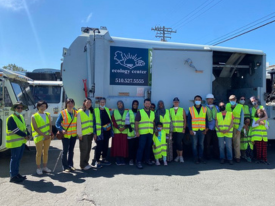
The Community Water Rights Project is fiscally sponsored by the Ecology Center to perform community environmental justice advocacy and research to educate decision makers and the general public about public rights in water and to suggest how enforcement of these rights can shape ecologically and socially responsible water management in California.
I. Background on Water Development Challenges and the CalFed ProcessII. A Call For Environmental Justice
I. Background on Water Development Challenges and the CalFed Process:
Historically, our natural environment and vulnerable human communities have borne more than their share of negative consequences of public water development policies. This has been particularly noticed in the case of subsistence fishing communities in many areas in the Bay-Delta system. Agricultural and industrial water pollution impact poorer communities far more than wealthy ones. Poor people depend on locally caught fish for a much larger share of the protein in their diets than their wealthier neighbors. Consequently, they ingest much higher levels of toxins and they don't have the choice of simply spending money elsewhere to change the composition of their diets as wealthier groups have. Similarly, poor communities have long had to deal with contaminated drinking water sources as wealthier neighbors have either pressured their local governments to remedy dangerous situations or turned to bottled water. Other disproportionate impacts can be predicted if agricultural water rights holders are allowed to sell their water to urban consumers who can pay much more for them than they could make by continuing their farming activities. Entire agricultural communities face the threat of abandonment and economic decline. The Community Water Rights project is joining with other urban and rural community organizations to ensure that environmental injustices do not persist unnoticed as our water system is adjusted to meet changing needs.
One of our strategies is to urge enforcement of traditional public rights of access and use of navigable waters and their tributaries. These rights are derived from the historic Public Trust Doctrine, the unique legal treatment whereby certain resources are held by the state in trust for present and future generations of Californians. Navigable waters and their tributaries (and associated fisheries) are the basis of this trust and the trust is supposed to benefit all the state's citizens without regard to their status as voters or power as economic actors. This is a particularly useful criterion when measuring the needs of politically and economically vulnerable communities. The duties of state trustees require actual attention to the consequences for all California citizens and particularly these vulnerable communities as the water that is the common heritage of all Californians is managed. Nowhere is this more important than to the families that depend on fish from the Bay and Delta for a major source of the protein in their diets.
The law does not allow trust resources to be damaged or given away in a manner inconsistent with trust purposes. Some see this as problematic as the state has embarked on a major initiative to implement "market solutions" to many water allocation challenges by expanding private claims to water resources. Another fundamental problem arises as public funds are used to "buy back" trust resources that were never intended to be privately owned in the first place. There are a whole host of issues that merit public attention and discussion. The Community Water Rights Project intends to contribute to this effort.
The Community Water Rights Project was initiated primarily to respond to the large scale water development process called CalFed. CalFed is the multi-year, multi-billion dollar collaboration between Federal and State agencies with the mission of solving some of California's intractable water planning and delivery dilemmas. The collaborating agencies seek to better manage the huge system of dams, reservoirs, aqueducts, pumps, levees and hydropower generating plants that serves to store and deliver California's fresh water from where it falls to where it is used. Some people have questioned whether this enormous plumbing system is actually serving our State in the most beneficial manner.
California's man-made plumbing system was created over a span of time with different promises made to various water users and their communities as the general social climate of the United States changed with passing time. At the beginning of the construction phase, water that flowed naturally to the sea was considered a foolish waste. As we've learned more about the natural systems that ultimately support us, the public has begun to perceive free flowing rivers supporting natural runs of salmon as valuable resources. The once seemingly limitless promise of irrigated agriculture in the Central Valley is appearing less and less sustainable. Soils are threatened with salinization; pesticides threaten the health of human, animal and plant communities alike and groundwater systems are polluted, over drafted and often irreparably damaged through land subsidance.
CalFed, with its focus San Francisco Bay Delta problems, aims to simultaneously restore ecosystems, enhance agricultural production, contribute to flood protection and reasonably supply California's growing urban centers with adequate supplies of high quality water and a significant source of hydropower. This is clearly a tall order since meeting one objective often means direct sacrifice of some of the others. Some people have begun to see the whole program as just a scheme to gain political consent for pumping more of northern California's water to developing urban areas in the arid south of the state.
Conceptual Overview of Community Water Rights Project Advocacy Strategy:
I. Public Trust Doctrine offers extensive legal precedent supporting ecologically sustainable resource management strategies; provides compelling language for effective public involvement in common resource stewardship.
II. California development is occurring within a public conversation emphasizing market-based approaches to all facets of resource management controversies. Little attention is given to historic public rights or the notion that some resources are not held for the purpose of private sale.
III. If public discussion of water management, where there is a long history of protection of public rights, fails to embrace the public trust doctrine, it will be far more difficult in the future to reclaim any notion of public domain in spheres where technological progress is extending private property rights faster than our public institutional infrastructure seems capable of handling in a deliberate manner (Patenting of new genetic forms introduced into our food system and the sale of communications frequencies come to mind). The Public Trust approach argues for a precautionary principle.
IV. Hopes for the future:
a. With properly formulated advocacy and education efforts, public agencies will undertake planning responsibilities in a manner that embraces public trust principles and anticipates that any actions might be measured against appropriate public trust criteria.
b. Community-based organizations will also learn about the trust and not hesitate to remind trustee agencies of their responsibilities under the doctrine. The public will participate in management decisions as persons with a beneficial interest in the outcome, not mere "third parties" that can be dismissed in negotiations between public agencies and private property holders.
c. The Public Trust Doctrine is just one of many components of responsible environmental stewardship. Effort is needed to develop language that will better articulate and enable ecologically sustainable practices and incorporate democratic values and concerns for social justice.
V. Acknowledgement of high costs of litigation and uncertainty of outcome in contemporary environment; possible risk of legislative coalition forming that might attempt to eviscerate the trust as recently occurred in Idaho.
VI. Incremental benefits of public education, continued participation in planning processes and generation of public program documents, academic discussion and publication of information understandable to the lay public.
II. A Call for Environmental Justice
The modern Environmental Justice Movement has gained considerable momentum in recent years as the general public has realized that our environment and poor and minority communities often bear more than their fair share of the burdens of industrial progress. Environmental, health and economic impacts are inflicted on our most vulnerable communities while benefits of harmful practices are enjoyed elsewhere. It has now been clearly recognized that water development policies can have disproportionate impacts on vulnerable communities. The Record of Decision on the Programmatic Environmental Impact Report/ Statement for the CalFed Program adopted an environmental justice criterion for all programs and committed to addressing potential environmental justice problems across these programs.
The Community Water Rights Project is represented on the Steering Committee of the Community Environmental Justice Coalition, facilitated by the staff of the Pacific Institute for Studies in Environment, Development and Security. (See: www.pacinst.org/justice.html) This coalition of community groups has been pursuing a multi-pronged strategy to ensure that Environmental Justice concerns remain a vibrant part of California Water Development. The Coalition supported the two recently appointed environmental justice advocates on the Bay Delta Advisory Commission. When final recommendations were made to the Cal Fed governing body, the Commission adopted an environmental justice principle and suggested a programmatic commitment to ensuring that the ability to monitor and address environmental justice issues was incorporated into public agency capacity.
Before the Record of Decision was issued on the CalFed Environmental Impact analysis, there was no real commitment on the part of this Federal-State collaborative organization to respond to public pressure on environmental justice issues. In fact, the framework agreement initially negotiated between Federal and State authorities didn't even mention the topic. The Community Environmental Justice Coalition mobilized a legislative education effort during the summer and the State Senate Select Committee on Environmental Justice was urged to write a letter.
As this forum for public participation in the CalFed Program is being phased out to be replaced by another public advisory body, the Community Water Rights Project has pressed for continuing public involvement as major decisions are being made in implementing the CalFed program. At the last official meeting of the Bay Delta Advisory Commission, CWRP Project Manager Michael Warburton made this statement:
III. Testimony of Michael Warburton- BDAC Meeting - November 15, 2000
I'm Michael Warburton, Project Manager of the Community Water Rights Project and a member of the Steering Committee for the Environmental Justice Coalition. First off, I'd like to say how pleased I am that the CalFed Record of Decision includes a commitment to ensuring fairness to vulnerable communities as California's water is managed in new ways. Likewise, I was happy to hear this morning that CalFed will be putting energy into generating broad-based public support for the program. But with uncertainty about funding and governance, I want to register my concern about just how public participation will play out in the emerging process.
Right now, it's not clear just how environmental justice concerns will be incorporated into diverse programs or how the interests of vulnerable communities might be represented in discussions shaping workplans. There is a direct link between one aspect of the legal treatment of water resources and public participation. You might be interested to know that along with the public trust in water comes a historic commitment to the poor and otherwise marginalized members of our society.
Since statehood, the trust has been part of California's resource laws. I won't go back to the Justinian Institutes of Ancient Rome, but I think an 1810 case in Pennsylvania is instructive. It was about a private claim to a fishery on a navigable river. The judges held that the common right to fishing was vested in the state and open to all. One justice based his decision partly on the colonial fish conservation statutes enacted in 1768 which quoted a petition saying that the public(and note this explicit reference) "including poor adjacent inhabitants" had been deprived use of the fishery because of the "almost total obstruction" of fish running up the river by dams. CalFed is clearly not the first entity to try to reconcile public and private claims to waters and fisheries affected by dams.
Also in the early 1800's, there were ongoing controversies between independent oyster harvesters who depended on public rights of access to bay fisheries and the far more wealthy riparian planters and oyster processors who tried to claim the coastal New Jersey oyster beds as their private property. Both the New Jersey Supreme Court and the Supreme Court of the United States concluded that the claims to private property violated the common law public trust. And because there had been such an outcry when the actions of wealthy planters threatened the livelihoods of entire fishing communities, the courts went further and declared that the colonial effort in America was founded on democratic principles which championed the rights of the poor. They said that the early development of our democratic institutions could not be reduced to a mere business venture.
This explicit attention to democratic principles makes the law particularly apt for application to California's water disputes and the plight of poor communities who have so often borne more than their share of negative environmental and economic consequences of water development.
Instead of inviting members of the public to participate as co-equal beneficiaries of a solemn trust, it sometimes looks to me as if CalFed agencies have chosen instead to ignore some of these legal mandates and accept many questionable current understandings as legitimate mostly because they are held by politically and economically powerful actors. It seems that people are in a hurry to privatize public assets and have the public buy back its own trust resources at inflated prices.
In my years of working on California Public Trust issues, I've had the privilege of meeting and corresponding with a retired State Appellate Judge who has always been deeply concerned with matters of social justice. In one postcard, he said to me, "I share your apprehension over the erosion of Public Trust Doctrine, but have had real trouble generating any confidence that, as our political system continues to degenerate into a mere formula for enriching those rich enough to pay for further enrichment, there is any real hope!" That is a pretty discouraging picture after more than twenty years on the bench.
But last Spring, when David Brower agreed to be on the Community Water Rights Project Advisory Committee, I was struck by his optimism. "There's a weather vane on the top of every courthouse," he said. "It's our job to make sure there's a wind blowing from a healthy direction." If the CalFed process can be truly open to public participation, I think there is indeed reason to be optimistic. We certainly will be working with that hope from the Environmental Justice standpoint.
IV. Proposed Environmental Justice Workplan for CalFed:
Working with EPA writers and various CalFed Agencies, the Steering Committee of the Environmental Justice Coalition contributed to the presentation by the US EPA of a proposal for an Environmental Justice Workplan for consideration by the CalFed Policy Group at the December 13, 2000 meeting in Sacramento. These documents set up a public process for approving environmental justice goals and objectives, and a systematic annual review of progress toward them. Copies of these documents and other resources can be found on the CalFed Website: http://calfed.water.ca.gov/current/justice.html
V. Recent Court Decisions that affect water policy:
Late in December of 2000, the California Supreme Court let stand a judgment by the State Appellate Court (Planning and Conservation League, et al v. Department of Water Resources) that water planning agencies and contractors of the State Water Project acted inappropriately and without adequate public participation in secretly negotiating an agreement that had public regulators giving up their right to reduce deliveries of project water if it were determined that all the project water could not be developed. The same secret agreement also illegally transferred (without charge) ownership of a 20,000 acre groundwater storage facility to a local water agency. This decision changes the landscape of water marketing in California and reminds all actors that certain responsibilities are involved when public assets are involved. In August, the Supreme Court of Hawaii relied upon a clarified version of its public trust doctrine to consider the reallocation of water between the environment, Hawaiian Natives and agricultural and new business users after a major sugar plantation closed its operations on the leeward side of Oahu. The Court included both ground and surface water in the trust, located the trust firmly in the State's Constitution, and recognized traditional native uses as protected uses within the trust. These developments demonstrate how increased attention to public rights can play an important role in resolving modern water controversies. In December, Lower courts in Washington reduced the jurisdiction of local water conservation boards so they can no longer hear cases involving the transfer of water rights that involve any change in the type of use for the water. The decision was made because these boards were tending to compromise statewide public interests in favor of local interests in such transactions. All of these decisions remind us that public rights will be increasingly important in solving difficult water allocation problems.